
Still "Entwined"

For my fourth annual trip to Vietnam since 2023, my wife Nancy and I arrived in Hanoi on February 26, which would have been my mother’s 104th birthday. She was an activist against the War in Vietnam when I went to serve there in 1968 as a “reluctant” Marine officer. On the morning of March 12, I was heading to Hanoi’s Noi Bai airport with my driver and friend Mr. Tuan for a flight to Ho Chi Minh City (Saigon); it was exactly 58 years after the grim morning my father and Nancy took me to the Philadelphia airport for my departure to the War.
We had a very “cozy studio” just off Lane 31, đường Xuân Diệu, Tay Ho – our old neighborhood -- midway between the houses we lived in during our two stints in Hanoi. The first of these was being torn apart in the inevitable Hanoi renovation, and the other has had a garish gold gate affixed to its front. Don’s Bistro, our favorite hangout, is long gone, its building replaced by a sumptuous lakeside residence.
On my every arrival in Hanoi, I remember John Converse’s lament in Robert Stone’s Dog Soldiers: “If I could just get back over to Nam, I’d probably be all right. You can hole up forever over there.”[1] Unfortunately, not….
A few days after arrival, as I was enjoying a cà phê nâu đá (iced coffee with condensed milk) in a Highlands Coffee on Xuan Dieu, I saw the first reports of Trump’s war in Iran. Highlands Coffee – Vietnam’s Starbucks, a thriving chain established by a returning “Việt Kiều” (Overseas Vietnamese) -- stands as a symbol of the senselessness of our American War in Vietnam. And now we’re making all the same mistakes – “déjà vu all over again.” Yes, yes, the “still unlearned lessons of Vietnam.” They’ve become almost a cliché or a self-fulfilling prophecy.
The senselessness of the War, and by analogy that of almost all of our subsequent wars, struck me again and again during this trip to Vietnam. My friend and Harvard roommate Steve Saltonstall, a confronter of Robert McNamara outside Quincy House in November 1966,
informed me of the death of Country Joe McDonald, whose 1967 ballad “I Feel Like I’m Fixin’ to Die Rag” invigorated many a music festival and antiwar rally:
And it’s one two three four
What are we fighting for?
Don’t ask me I don’t give a damn
We’re off to Vietnam.
Five six seven
Open up the pearly gates.
You don’t have to reason why
Whoopee! We’re all gonna die.[2]
I drank a bia Hà Nội at Thủy Tạ beside Hoàn Kiếm Lake while reading Philip and William Taubman’s new book McNamara at War[3] as the usual crowds of Hanoians and tourists circled the iconic heart of the city on a beautiful early spring afternoon. The book, which might well have been subtitled “A Slow-Motion Greek Tragedy,” increased somewhat my empathy for McNamara and LBJ, although this by no means exonerated them. Both repeatedly voiced tortured versions of “there’s no way for us to win this war but also no way for us to get out of it.” The falsity of such an unsolvable equation does not make its proponents any less tragic.
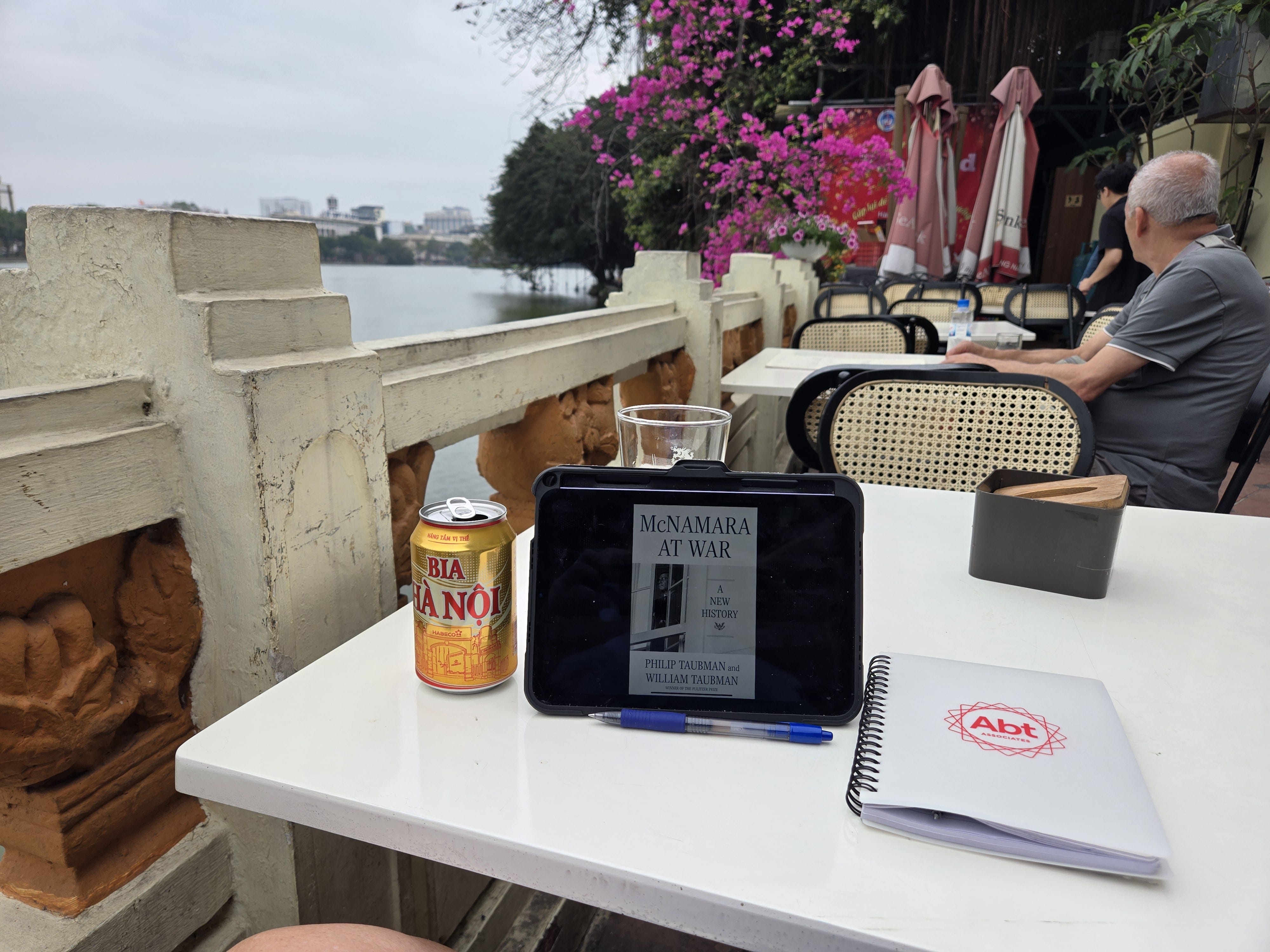
Reading McNamara at War at Thủy Tạ by Hoàn Kiếm Lake
I stayed at the Rex Hotel in Ho Chi Minh City, site of the infamous “5 o’clock follies” -- the daily briefings at which Military Assistance Command Vietnam (MACV) officers lied about the progress and prospects of the war. I drank a Sài Gòn Đỏ (Saigon Red beer) at the Rex’s rooftop bar and continued my reading of McNamara at War as a Vietnamese band played songs of the 60s – “I Saw Her Standing There,” Santana’s “Oye Como Va,” “La Bamba,” -- and even Trump’s favorite “YMCA,” and the ever rising skyline of HCMC flashed and glittered all around me.
I sat by the pool at La Residence in Hue, in sight of the Citadel, focus of one of the bloodiest battles of the war. I thought of Mr. Vinh, of whose passing I had just learned. He was an ARVN veteran who had worked as a translator for U.S. Army units, spent several years in a re-education camp after the War, and then returned to live in Hue and became a guide for “DMZ Tours.” Over the years, Mr. Vinh took me and my family members and friends on many informative and moving tours of the Quang Tri battlefields, including Khe Sanh. We became friends. With the assistance of the wonderful Ms. “Moon” of La Residence, I offered my condolences to Mr. Vinh’s family and we visited his grave.
I also visited the place where W.D. “Bill” Ehrhart, poet and memoirist of the War, was wounded.
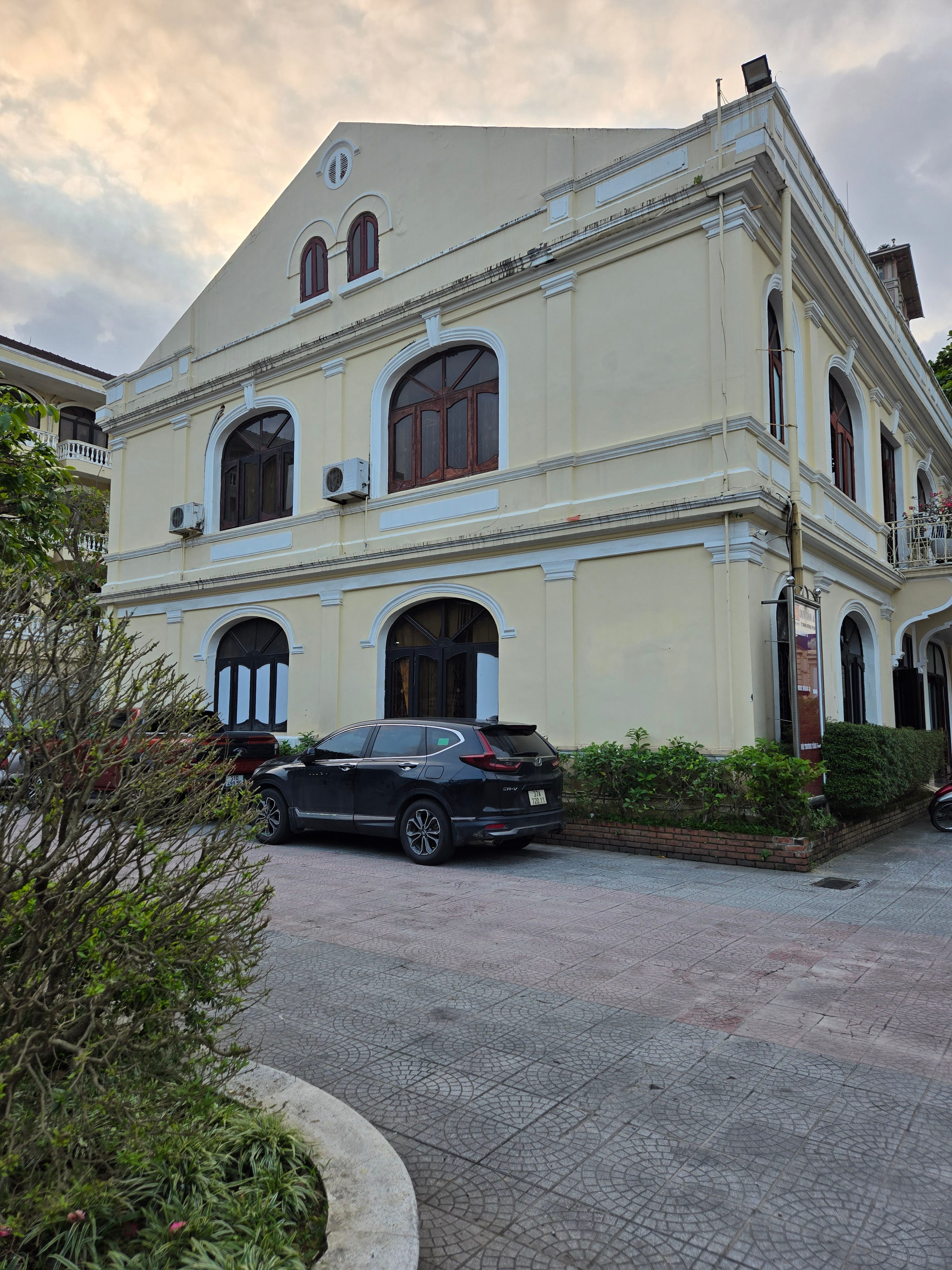
Bill Ehrhart was wounded by an NVA rocket-propelled grenade while just inside the second-floor window on the right.
during the Battle of Hue. It is a renovated building that is now part of the 3-star Duy Tan Hotel. When Bill revisited Hue in 2011, he wrote that Vietnam “not a War but a country.”
I found some relics of the Quang Tri airfield just across Route 1 from the site of the 3rd Marine Division’s field hospital where I served in 1968-1969. I saw a group of kids playing soccer nearby, just as I had seen when I visited the Hue Citadel in 1997 on my first trip back to Vietnam since the War. Again, I took a photo of the kids who were enjoying a peaceful life in their country.
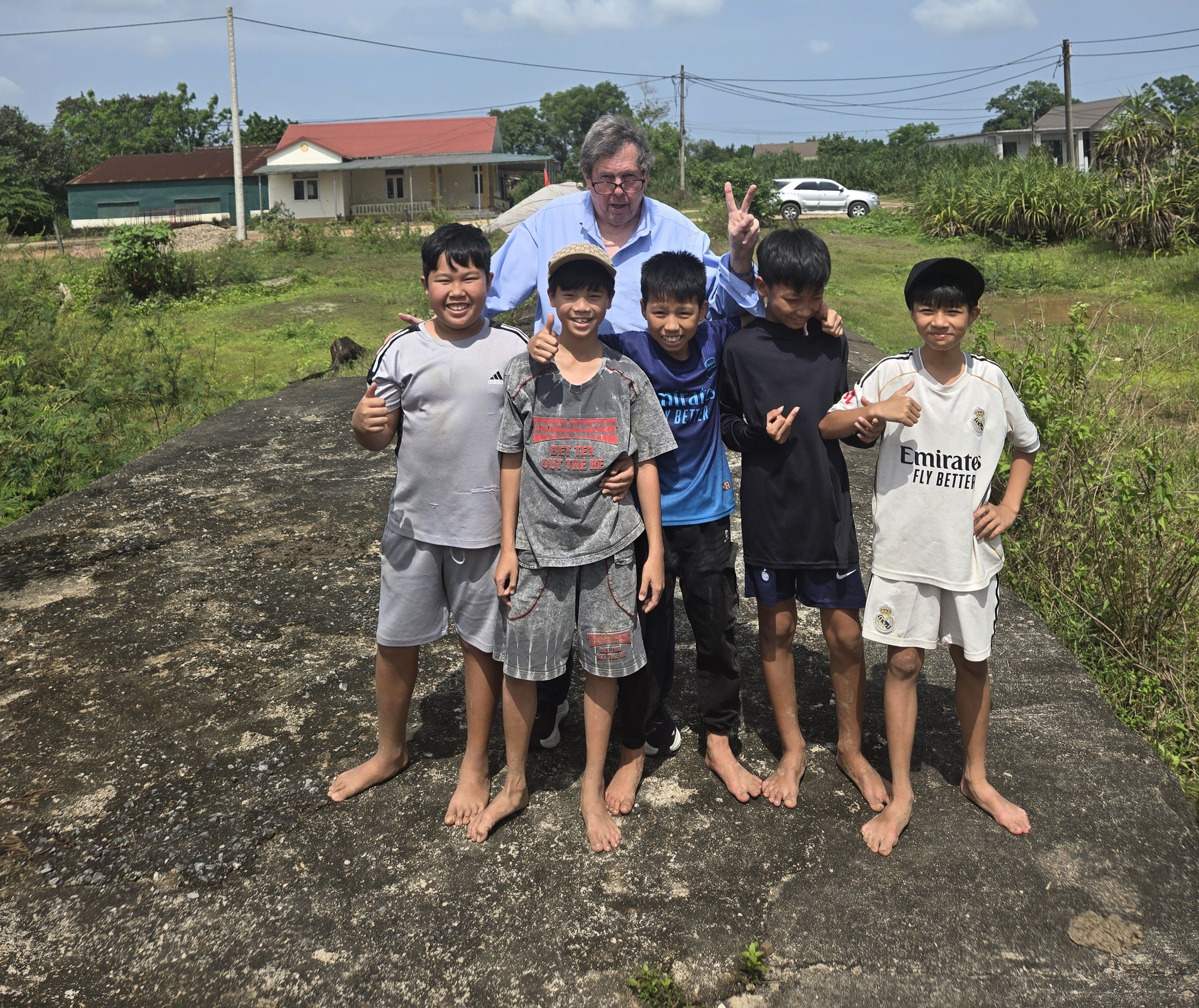
Kids on the relic of Quang Tri Airstrip
And finally, I gathered with dear friends and colleagues for a “farewell, for now” party at Standing Bar overlooking Trúc Bạch Lake, where Lt. John McCain’s parachute came down in 1967 and he was taken prisoner of war. Later, Senator McCain became a champion of U.S.-Vietnam reconciliation.
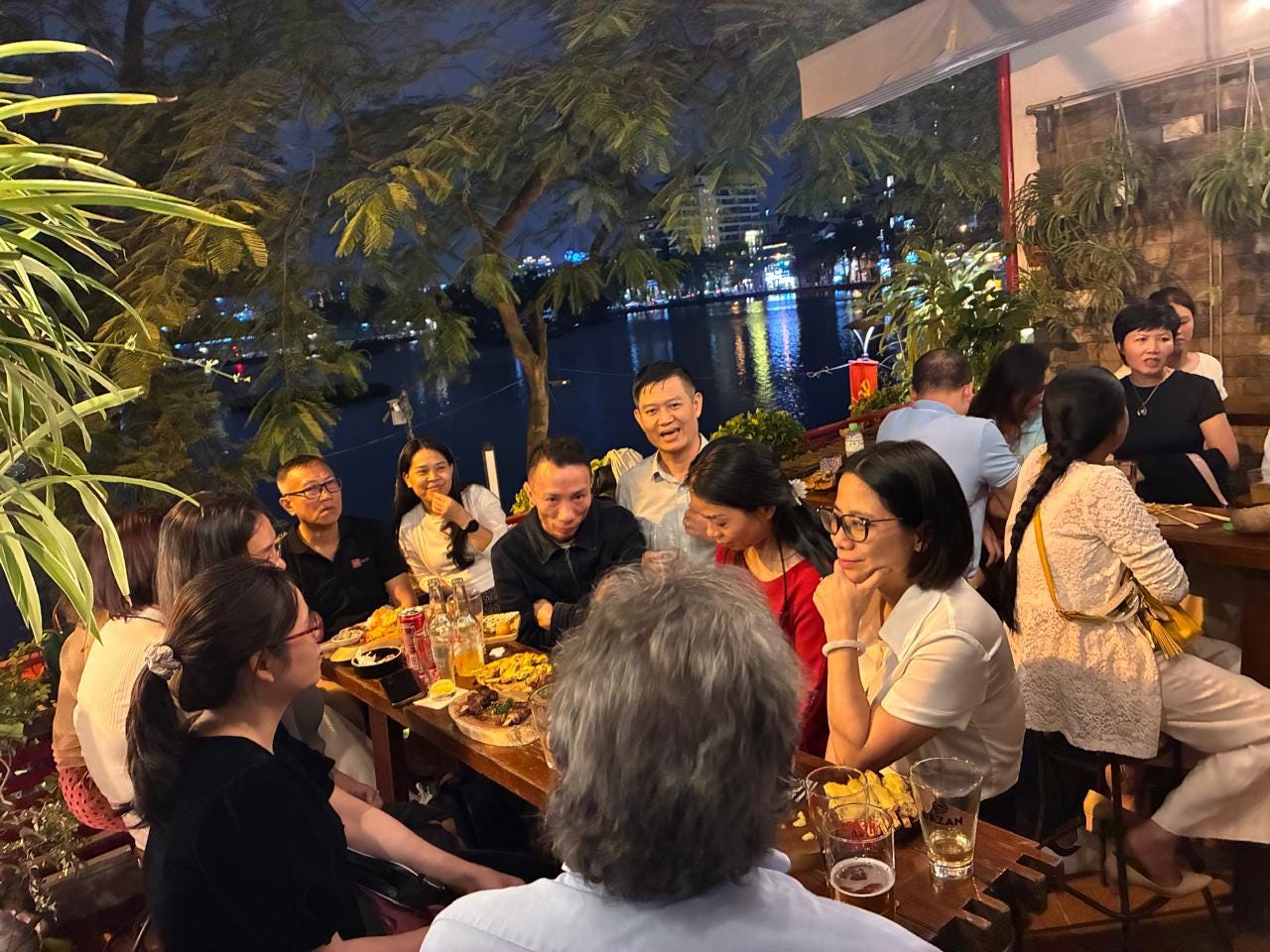
“Farewell, for now” at Standing Bar, by Trúc Bạch Lake (that’s the back of my head in the foreground)
I often wondered if the Vietnamese people had forgiven the U.S. for the war, I usually thought so, given how well Americans visitors are treated by the Vietnamese. This reminded me of Ho Chi Minh’s saying that the Vietnamese were fighting the American government, not the American people.
But a friend challenged me on the matter of forgiveness, insisting that the pain and suffering of the war would never be forgotten by the Vietnamese but that the government and people have decided it’s best to wish for peace with everyone. Out of politeness and a realization that harboring hate and resentment helps no one, the people try to avoid speaking about the war and its incredibly heavy cost, or America’s responsibility for Vietnam’s suffering.
The Bookworm, Hanoi’s English-language bookstore, no longer has a separate section on the American War. Books on War are simply interfiled with general non-fiction. Another important factor is that three-quarters of Vietnam’s population were born since the war ended in 1975 and so have no direct recollection of it. All this makes sense but I realize that these changes do not quite equal forgiveness.
Reconciliation between the U.S. and Vietnam has been slow and arduous but has achieved some important results. Project Renew, which I visited on this trip, has removed much unexploded ordnance (UXO) in Quang Tri, “the most bombed place on earth,” and other organizations are beginning to work in several other heavily bombed provinces. Still, much UXO remains and so community education and support for people disabled by accidents involving bombs and mines continues to be important.
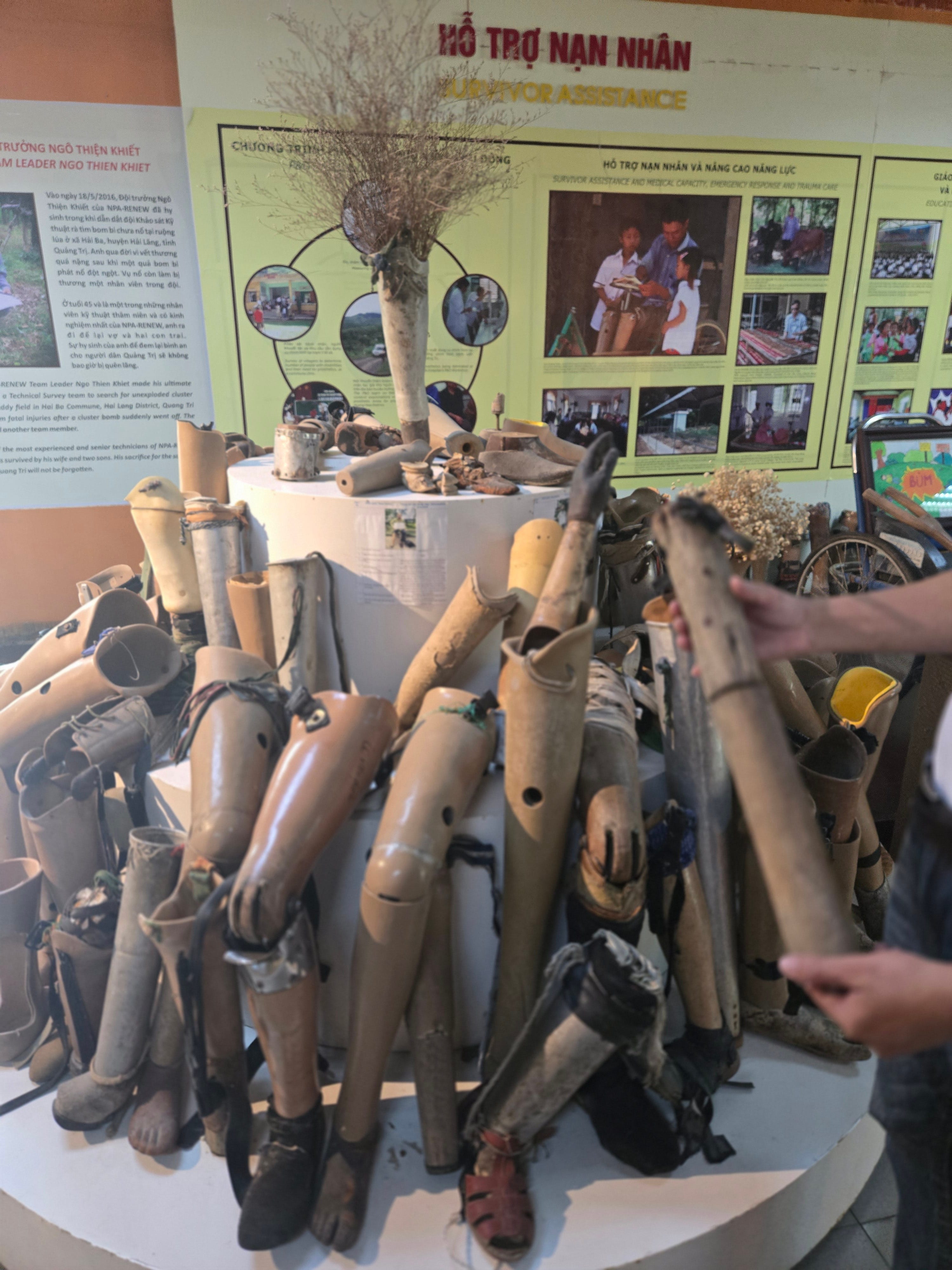
Prosthetics at Project Renew’s museum in Dong Ha, Quang Tri
Agent Orange mitigation has been completed at Danang Airbase and is proceeding in Bien Hoa and the A Shau Valley. The work of locating the remains of hundreds of thousands of missing Vietnamese soldiers from both sides, has only just begun. The U.S has assisted in this effort by identifying and turning over to the Vietnamese government American military documents about battle sites and other possible locations of remains. Trump’s defense secretary Pete Hegseth visited Vietnam in November 2025 and voiced support for the various war legacies projects,[4] but U.S. funding cuts have severely imperiled continued progress.
Reconciliation within Vietnam also remains a work in progress. Discrimination continues against descendants of ARVN soldiers and partisans and officials of South Vietnam. However, the government has allowed Việt Kiều to return to live and establish businesses, such as Highlands Coffee. Many official accounts and museum exhibits continue to refer to the ARVN and South Vietnam government as “puppets.” Some people refuse to use this demeaning language, recognizing that the War was in an important sense a civil war.
A revised governmental account of the War emerges in the new Military Museum. The building is massive and its exhibits are celebratory.
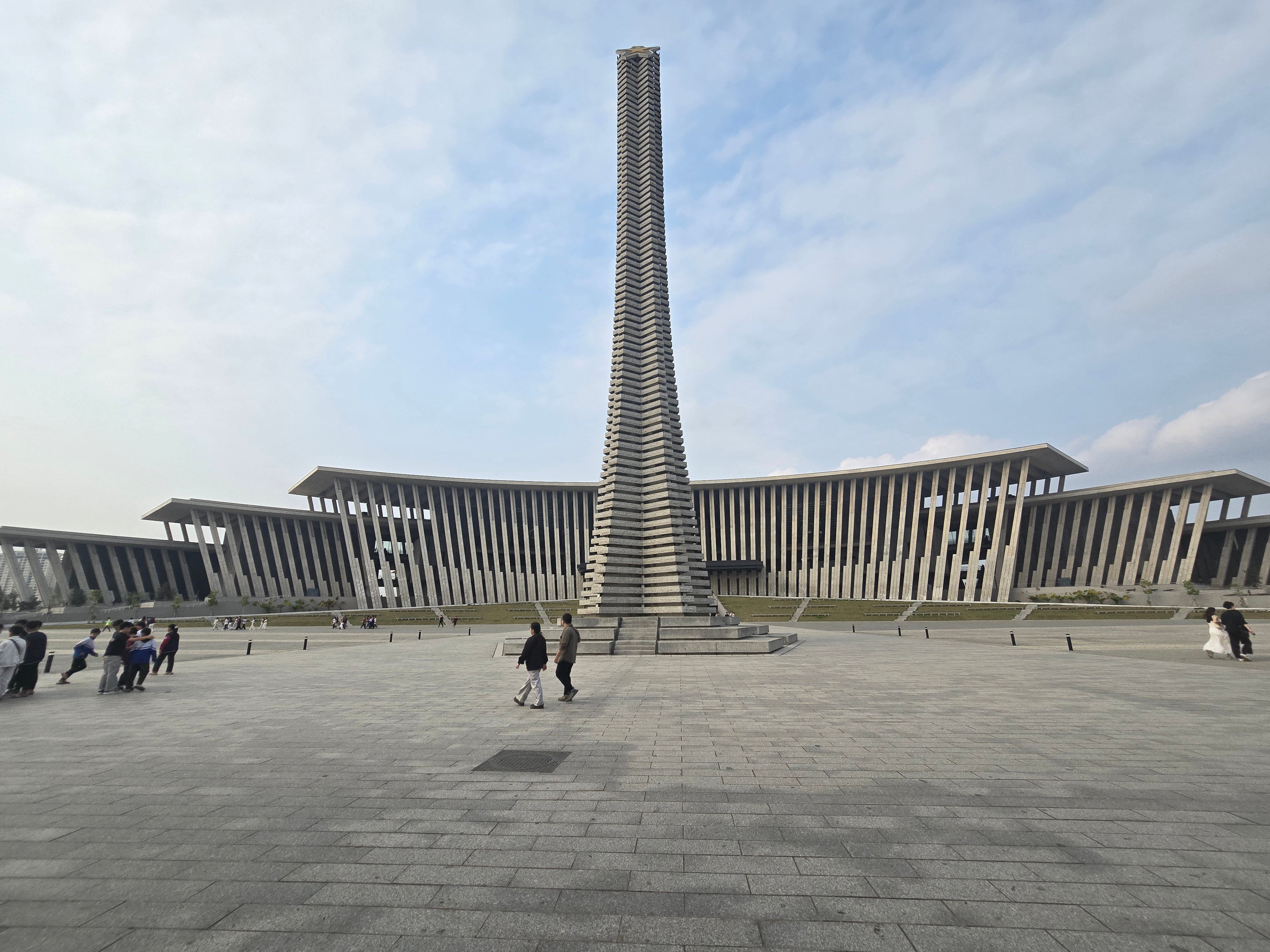
The new Military Museum, Hanoi
Filled with big school groups, the museum presents what could almost be termed a “sanitized” version of Vietnam’s victory, justifiably called “glorious.” After all, this small, poor country defeated the wealthiest and most powerful nation in the world in a remarkable replay of the David and Goliath story. The museum’s retelling focuses not on the details and costs of specific battles (e.g., virtually nothing is shown of the battles of Hue or Khe Sanh) but rather on broad themes and periods of victory – seemingly achieved almost automatically by the Vietnamese people. The heavy losses of U.S. and “puppet” forces are emphasized but NVA, Viet Cong, and civilian casualties are barely mentioned. The 58,000 American deaths–which would result in a much larger number if one totaled the estimates of losses in battles and campaigns from government accounts and memoirs -- are repeatedly emphasized, while neither the estimated three million Vietnamese dead nor the hundreds of thousands still missing are ever mentioned. Politburo head Le Duan’s reputation is sullied for many Vietnamese people by his perceived responsibility for this vast cost. He is largely ignored in the museum’s account despite the fact that it was his relentless, albeit costly, strategy that won the war for Vietnam.
The Women’s Museum is much more honest than the Military Museum about the suffering and bravery of Vietnamese women in the war. But it also presents a somewhat sanitized picture of Vietnamese marriage and domestic life. It must be said that male chauvinism is not unique to Vietnam but remains prominent in most countries, notably the United States. The Women’s Museum simply omits men from Vietnamese domestic life, recognizing no male role in birth, childcare, child rearing, or housework.
In the first fifteen years of this century, civil society blossomed in Vietnam – non-governmental organizations (NGOs), community-based groups, and social enterprises. They contributed substantially to improvements in Vietnam’s policies, practices, and services in many areas: public health, poverty reduction, environmental protection, and war legacies. This work has continued in more recent years, to the benefit of the Vietnamese people. But the strategy of civil society has had to change, as the government and Party became intolerant of policy advocacy from outside, especially when funded by foreign countries, especially by the U.S.
Despite the progress of reconciliation and the establishment of formal bilateral partnerships, Vietnam remains very resistant to outside interference, doubtless influenced by its difficult history. Indeed, the elimination of USAID and the drastic cuts in U.S. funding for health, environmental, human rights, and socio-economic development programs may have been viewed by the Vietnamese government as “a blessing in disguise.” U.S. government funding, including the HIV/AIDS programs I worked on, also supported substantial policy advocacy.
In order to survive, Vietnamese civil society organizations have had to focus on direct service delivery consistent with government policies and structures and eliminate overt policy advocacy. Some organizations have been unable or unwilling to shift focus in this way and have disappeared. Others, however, have been very successful and continue to provide valuable services in poverty reduction, disaster relief, environmental protection, war legacies, and some areas of public health. And, while overt policy advocacy is essentially prohibited, it is quite possible that demonstration of effective services could result in government adoption of improved policies. In fact, Vietnam has a history of adopting policies based on sound data and scientific evidence – as in its adoption of needle and syringe programs and other “harm reduction” strategies in HIV/AIDS prevention much more quickly than in the U.S.
The Centre for Supporting Community Development Initiatives (SCDI) stands as a prime example of a civil society organization that has evolved to survive and thrive. SCDI deserves public and governmental recognition and support for its valuable and effectively delivered services in public health, poverty reduction, and disaster relief.
Việt Phủ Thành Chương, a self-styled “art palace” and collection of spiritual and cultural buildings assembled by artist Thành Chương in a verdant setting on the outskirts of Hanoi, has become one of my favorite places in Vietnam. Its website terms it “the Residence of the Soul of Vietnam.”[5] Indeed, it is a place of natural and artistic beauty, and thus a very peaceful and soulful place. And, for aging visitors like me, Việt Phủ generously offers canes to help with the many steps without railings and lots of nice places to sit down, rest, and take in the peace, quiet, and beauty.
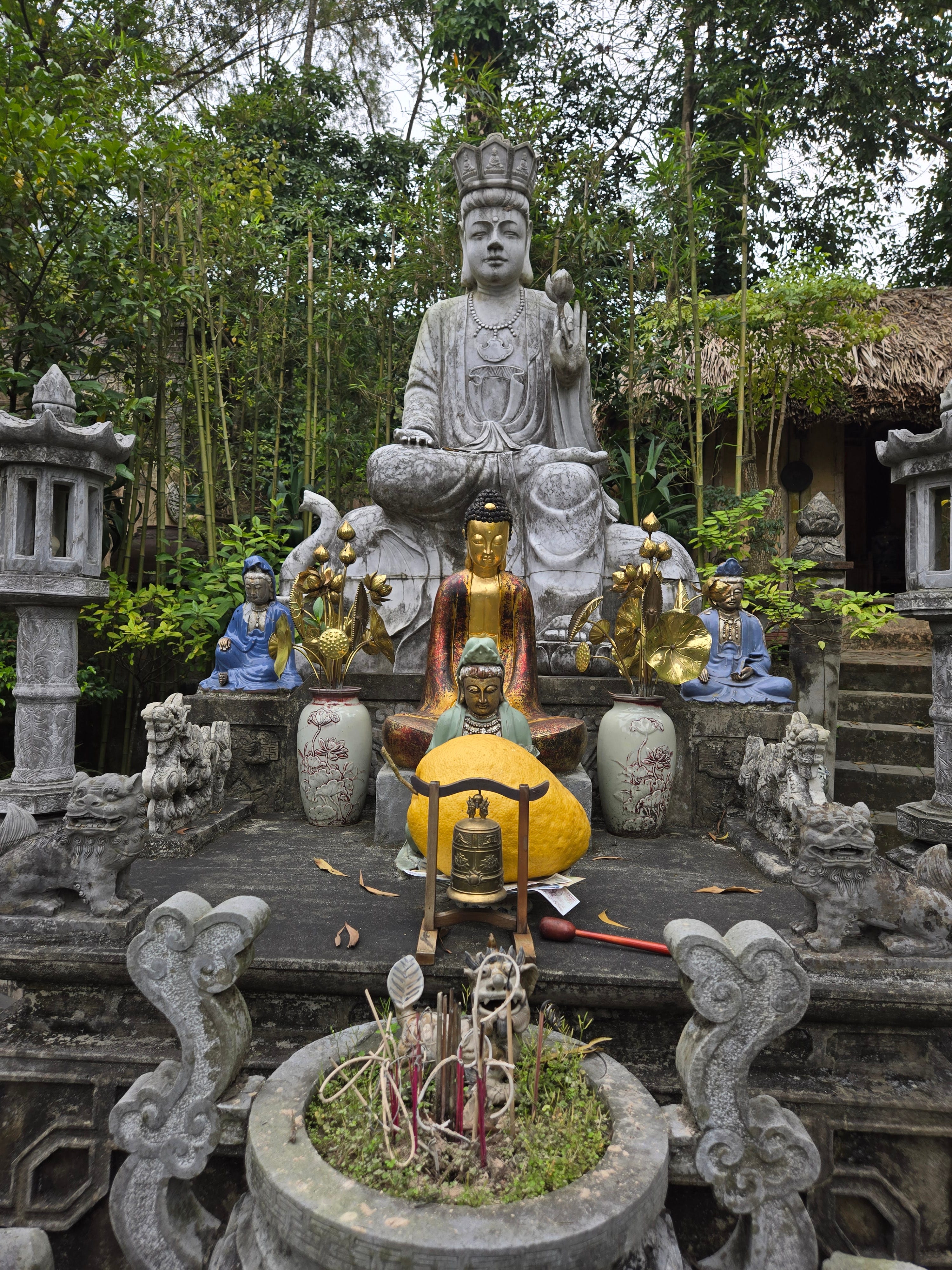
Việt Phủ Thành Chương, Sóc Sơn, Hà Nội
I have deep emotions about the War, shame, and regret for what my country did and also for my failure to resist the War. But during this visit I was, at some level, taken in by the new sanitized and almost “pain-free” presentation of the War. Việt Phủ Thành Chương seems to reflect the peaceful “soul” of Vietnam – or at least an important, perhaps aspirational, part of it.
This is very alluring. I found myself thinking about moving to Vietnam. But it’s impossible, of course. I have many powerful reasons to stay where I am –my family, my Vietnamese style three-generation home, friends, church community, our summer place in Maine, etc., etc. I also realize that John Converse of Dog Soldiers was wrong – there is no way to escape and nowhere to hide, even if one wanted to. I am inextricably “entwined” with my home, family, and native country. Nevertheless, I also remain “entwined with Vietnam” and I intend to return every year for as long as I can.
[1] Robert Stone, Dog Soldiers. New York: Ballantine Books, 1978, p. 127.
[2] For full lyrics, see https://genius.com/Country-joe-and-the-fish-the-fish-cheer-i-feel-like-im-fixin-to-die-rag-lyrics.
[3] Philip and William Taubman, McNamara at War: A New History. New York: W.W. Norton & Co., 2025.
[4] Damien Cave and Tung Ngo, “Hegseth vows stronger ties with a Vietnam skeptical of U.S. commitment,” New York Times, November 3, 2025.
[5] For more information, see https://www.vietphuthanhchuong.com.vn/
.
Thank you, Ted for your continuation of being entwined with Vietnam.
Brilliant essay on your complicated feelings about and history with Vietnam. You speak for an entire generation, I feel, those who went and those who found a way not to go. Both groups stand in the shadow of that time and that war.